

The Physical Economy Is Being Rebuilt
Capital is rotating back toward the real economy. We invest in capital-intensive businesses where hard tech, automation, and operational discipline compound that shift.
Where Real-World Outcomes and Economics Align
We invest where real-world constraints create opportunity — in companies building efficiency, resilience, and domestic capacity.
Bridging the Divide
We sit at the intersection of hard tech innovation and the deployment of critical industrial and private infrastructure assets.
Our Strategy
Where the problem is the opportunity.
Altes’ U.S. Reindustrialization focuses on growth-stage businesses addressing real constraints across energy systems, industrial inputs, supply chains, manufacturing, and critical infrastructure.
We look for companies where strong economics and real-world outcomes are closely linked — because the market needs the problem solved. In these sectors, improvements in reliability, efficiency, resource use, domestic capacity, and operational visibility are not separate from the investment case. They can be central to cost structure, customer demand, financing, and long-term value creation.
Why Now?
Four forces are driving a generational rebuilding of the physical economy.
Energy systems
Rising power demand, grid stress, electrification, and infrastructure modernization are creating demand for more reliable and efficient energy solutions.
AI infrastructure
AI is increasing demand for power, data infrastructure, automation, and more efficient physical systems.
Supply-chain resilience
Advanced manufacturing, industrial inputs, and critical materials are becoming central to competitiveness, reliability, and long-term economic resilience.
Domestic manufacturing
Recent disruptions have exposed the need for more reliable domestic and allied supply chains.
Core Pillars
Accessing constraint-driven industrial opportunities.
Our approach focuses on sectors where capital, technology, and operational execution can help rebuild the physical economy and address real-world bottlenecks.
Advanced Manufacturing
Industrial Capacity
Companies expanding domestic manufacturing capacity in sectors where supply is constrained or strategically important.
Production Automation
Robotics, software, and systems that improve throughput, precision, reliability, and labor productivity.
Supply Chain Resilience
Businesses that strengthen domestic production networks, reduce dependency on fragile inputs, or improve reliability of critical supply chains.
Energy and Infrastructure
Grid Modernization
Solutions that improve grid reliability, flexibility, interconnection, transmission, distribution, and power availability.
Power Systems
Businesses addressing industrial power needs, including generation, storage, electrification, and energy management.
Enabling Infrastructure
Critical systems, services, and platforms that help industrial assets get financed, permitted, built, operated, and scaled.
Critical Materials
Strategic Inputs
Companies securing, producing, or improving access to materials and intermediates required by modern industry.
Capabilities that refine, upgrade, recycle, or transform materials into usable industrial inputs.
Resource Security
Businesses reducing bottlenecks and dependency risks across domestic or allied critical-material supply chains.
Case Study
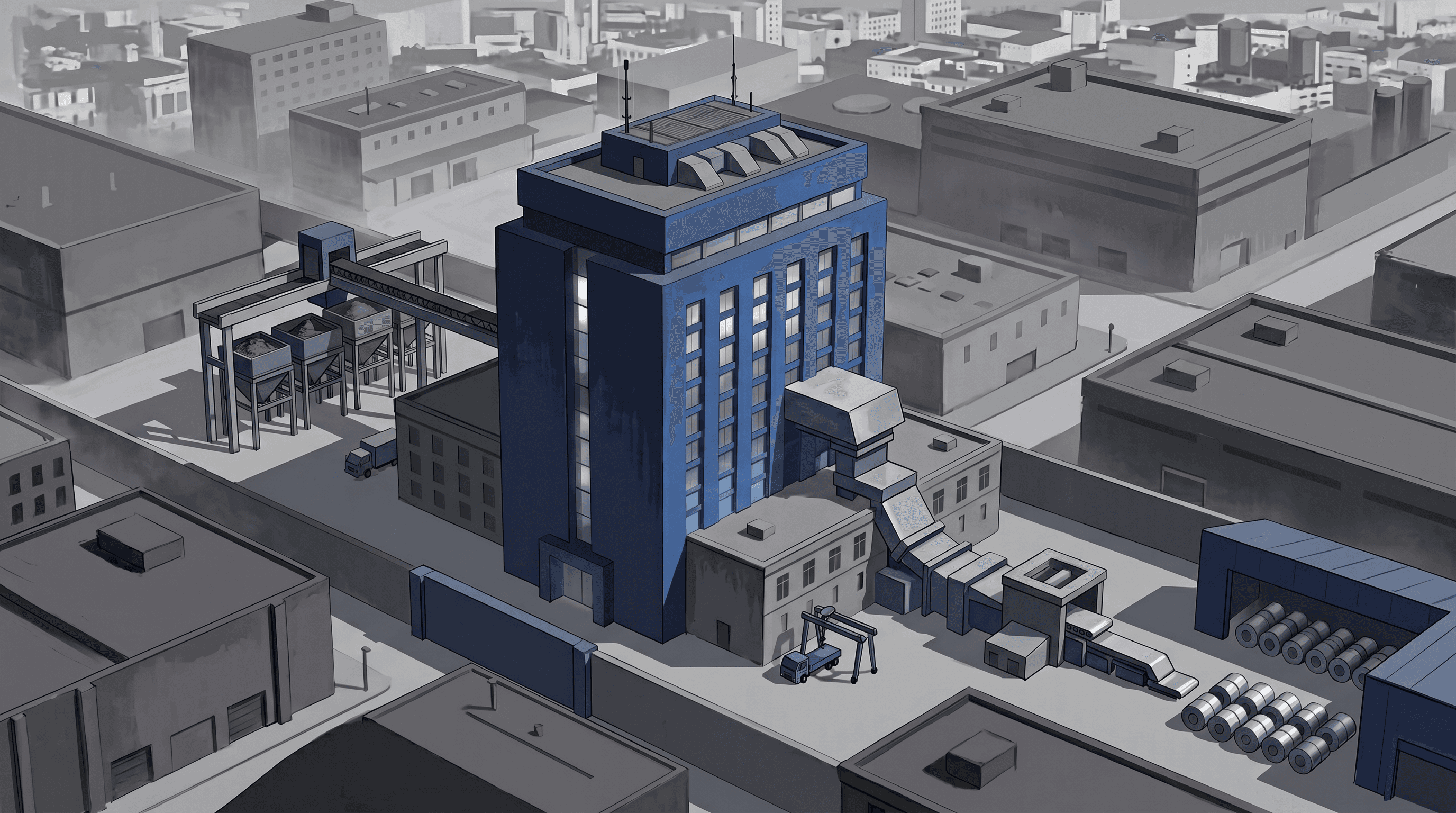
Industrial Inputs and Green Steel
One example of this thesis is the need for more reliable, lower-intensity inputs for domestic steel production. U.S. steelmakers increasingly require high-quality ore-based metallics to support electric arc furnace production, yet the domestic supply chain remains constrained.
Businesses that address that bottleneck can appeal to different investors for different reasons — supply-chain resilience, domestic industrial capacity, cost stability, and emissions intensity — while the underlying commercial need remains the same.
Our Framework
How we underwrite value
We evaluate companies through both financial and operating lenses, focusing on revenue durability, energy intensity, resource alignment, competitive moats, sourcing, stakeholder alignment, operational viability, and long-term value creation.
01
Financial durability
Revenue quality, margin structure, and capital efficiency across a full cycle.
02
Operational alignment
Sourcing, resource efficiency, and operational visibility across capital-intensive systems.
03
Structural necessity
Whether the market genuinely needs the problem solved — independent of policy.
Frequently Asked Questions
What is the core investment thesis of U.S. Reindustrialization?
How does U.S. Reindustrialization differ from traditional venture or growth equity investing?
What types of companies does the strategy target?
What are the core investment pillars?
Why does resource efficiency matter to the investment thesis?
What role does AI play in the strategy?
What are the primary risks?
Contact Us
Learn more about Altes’ approach to U.S. Reindustrialization by following our research or contact us today.